Bag-and-Mask Ventilation
Indication for bag and mask ventilation:
- Apnea or gasping respiration.
- Heart rate less than 100 beats per minute.
Equipments
- Ambu bag with reservoir
- Facemask of appropriate size
- Oxygen source
- Pulse oximeter
- Stethoscope
PROCEDURE
-
All resuscitation equipments must be functionally checked at each shift.
-
Make sure that the baby is connected to a pulse oximeter.
-
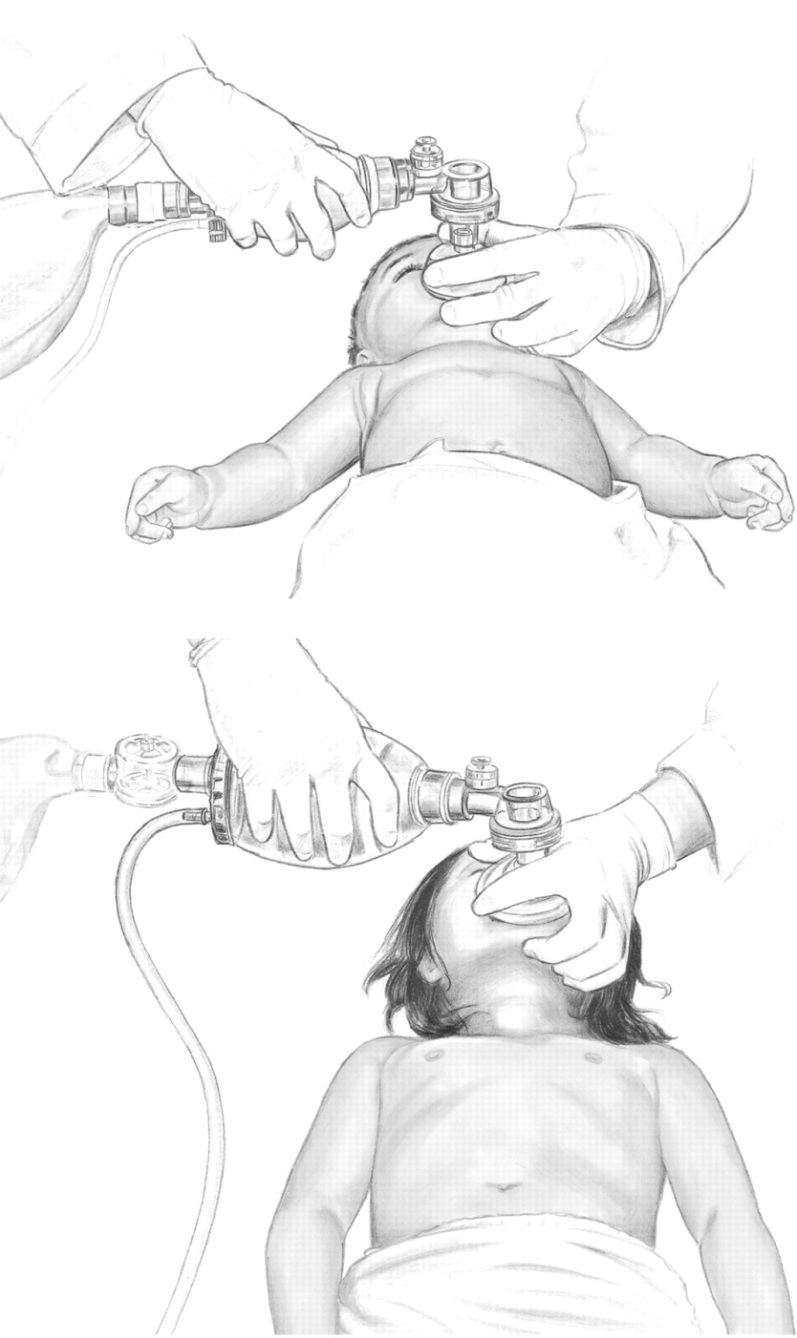
Position the baby with the neck slightly extended and place a shoulder roll of cotton or linen for better positioning and support.
-
Apply facemask and ensure proper seal without applying excessive pressure to the baby's face or neck. The mask should cover the chin, mouth and nose but should not cover the eyes of the baby.
-
Rate of ventilation should be 40 to 60 breaths per minute.
-
Connect oxygen source to the ambu bag. Set the oxygen flow rate to 8 - 10 L/min. Ensure that the reservoir is connected to ambu bag.
-
Observe the chest expansion. If inadequate:
-
Reapply the face mask for better seal
-
Reposition the head
-
Suction secretions
-
Open the infant’s mouth slightly
-
Increase pressure
-
-
Re-evaluate the respiration rate, heart rate and oxygenation (pulse oximetry, colour).
-
If the baby has a feeding tube, aspirate the gastric content during bag-and-mask ventilation and keep the tube open to prevent gastric distention.
-
If an oral feeding tube is not in place and gastric distention occurs, insert an oral feeding tube (8 Fr) and aspirate the gastric content with 5-10 ml syringe and keep the catheter open.
-
The adequacy of bag-and-mask ventilation should be checked by auscultation of breath sound, visualization of chest wall movement, monitoring the increment in heart rate and oxygen saturation.
-
If bag and mask ventilation is ineffective or there is a need for prolonged ventilation, endotracheal intubation should be performed.
Potential complications of bag and mask ventilation: Pneumothorax, Abdominal distension occurs when positive pressures are applied at oropharynx and it can lead to regurgitation of gastric contents and their aspiration.
References
- Neonatal Intensive Care by Merenstein and Gardner, 7th edition (2011)
- Comprehensive Neonatal Nursing Care by Kenner and Lott, 5th edition (2014)
- Core Curriculum for Neonatal Intensive Nursing by Verklan and Walden, 3 edition (2004)
Document Information
Version: 2.0
Published: August 20, 2015
Revised by: Dr Chetan Meena
Contributors: Nurse Ajeeta George, JK Lone Hospital, SMS Medical College, Jaipur
Previous Versions: v1.0